An air shower is a small chamber equipped with a "high-velocity air blast" function, serving as a mandatory passageway for personnel or goods entering a cleanroom.
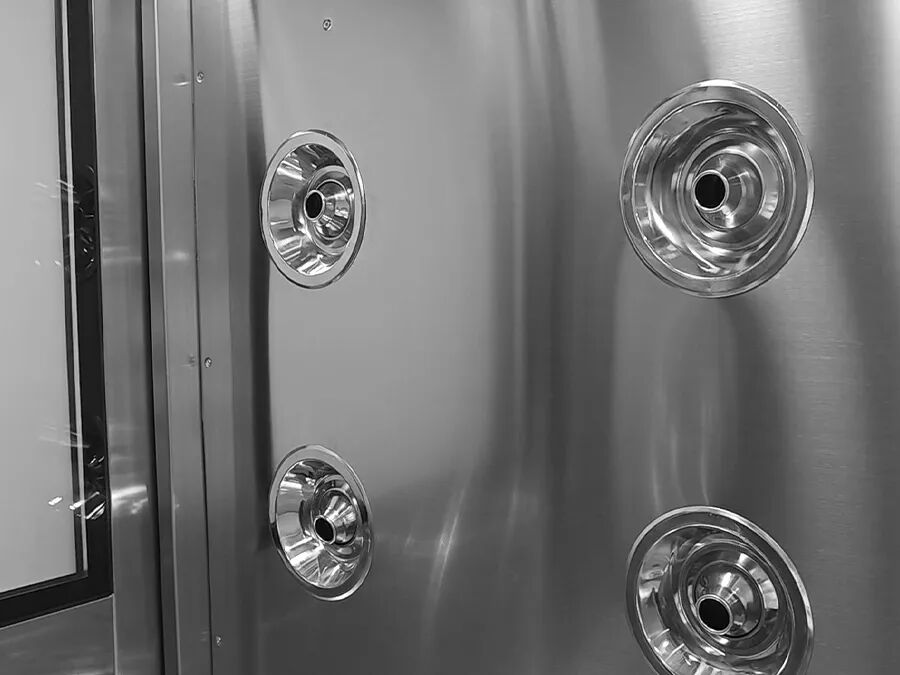
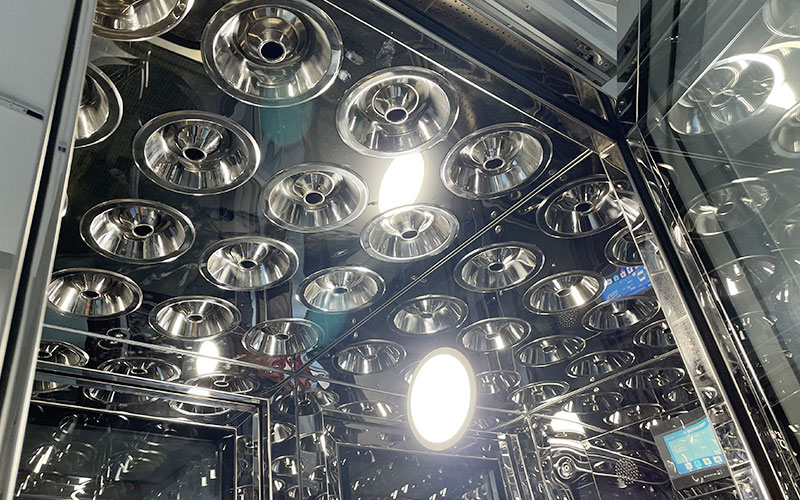
Its operating principle is straightforward: a fan draws in ambient air, passing it first through a pre-filter and then through a HEPA filter (with a filtration efficiency exceeding 99.99%) to produce ultra-clean air. This air is then blasted from nozzles at speeds exceeding 20 m/s onto the person inside. This powerful airflow effectively dislodges tiny contaminants—such as dust and skin flakes—adhering to clothing, hair, and carried items. The dislodged particles are captured by the system and recirculated through the filtration loop. Additionally, the dual-door interlocking design (ensuring one door cannot open while the other is open) acts as an airlock, preventing unpurified air from directly entering the cleanroom.
The Air Shower "Family Tree": Types and Selection
There is a wide variety of air showers on the market; choosing the wrong one not only wastes money but can also cause long queues at the workshop entrance during peak hours.
First, determine your cleanroom classification requirements: if your workshop is ISO Class 8 (Class 100,000), standard gowning procedures may suffice; however, for ISO Class 7 (Class 10,000) and above, an air shower is "highly recommended" or even mandatory.
Select the model based on "throughput capacity"—this is the most critical factor. Do not rely merely on a subjective sense of "size"; instead, calculate the number of people who need to pass through within a 10-minute peak period. Choosing a unit that is too small causes workers to queue, delaying production, while choosing one that is too large wastes space and budget.
|
Type |
Applicable Scenarios |
10-minute throughput capacity (approx.) |
|
Single-person single/double air shower |
Small workshop, ≤30 people during peak periods. |
30 people |
|
Two-person, dual-air-shower unit |
Medium-sized workshop; 30–60 people during peak periods. |
60 people |
|
Three-person dual-blow / tunnel-type |
Large-scale workshop; accommodates 60 or more people during peak periods or operates with continuous production. |
Over 90 people (walk-through type allowing continuous passage) |
Material determines lifespan and compliance: Industries requiring frequent cleaning and disinfection—such as food, pharmaceuticals, and cosmetics—must use stainless steel (SUS304 or 316) to ensure corrosion and rust resistance. For general industries like electronics, lower-cost powder-coated cold-rolled steel is a viable option.
"Pitfalls" that manufacturers won't explicitly tell you about.
Industry veterans reveal certain "unspoken rules" regarding air shower selection; overlook them, and you might run into trouble:
Air speed isn't the only factor; uniformity matters more. Don't just listen to sales pitches boasting "25 m/s air speed"; the key is whether the airflow covers the entire body. Poor nozzle layout—where air hits only the chest while missing the underarms and trouser legs—renders the process ineffective. A good design creates cross-covering "turbulent flow," leaving no dead zones.
The interlocking mechanism is a "lifesaver": Door interlocking is crucial for preventing contamination of the cleanroom. Low-end models use electromagnetic locks that fail during power outages; pneumatic cylinder interlocks offer higher reliability by maintaining the lock mechanically—a preferred choice for food and pharmaceutical plants.
Don't overlook a key metric: noise. If the air shower exceeds 75 decibels, operators may find the noise unbearable and try to "skip" the air shower process, rendering your cleanroom management protocols useless. During acceptance testing, it is essential to ensure the noise level is ≤65 dB at a distance of one meter.
Making the most of it: Proper use and maintenance.
Purchasing the unit is just the first step; proper usage is what really counts.
Operational workflow: Enter the air shower and close the door; the air shower cycle starts automatically (or via infrared sensor), locking both doors. Once the cycle ends (usually 15–20 seconds), the entrance door remains locked, allowing exit only through the exit door. Forcing both doors open simultaneously is strictly prohibited, as it can damage the interlocking system.
Daily maintenance is the key to longevity: The most common failure point isn't the fan, but filter clogging.
Pre-filter: Acts like a "face mask"; requires cleaning or replacement every 1–6 months. If you notice reduced airflow, check this filter first for darkening or dust accumulation.
HEPA filter: Acts like the "lungs"; typically requires replacement every 6–12 months. After the replacement, you must use a particle counter to inspect the frame and ensure there are no leaks; otherwise, it will turn into a "dust-blowing chamber."